


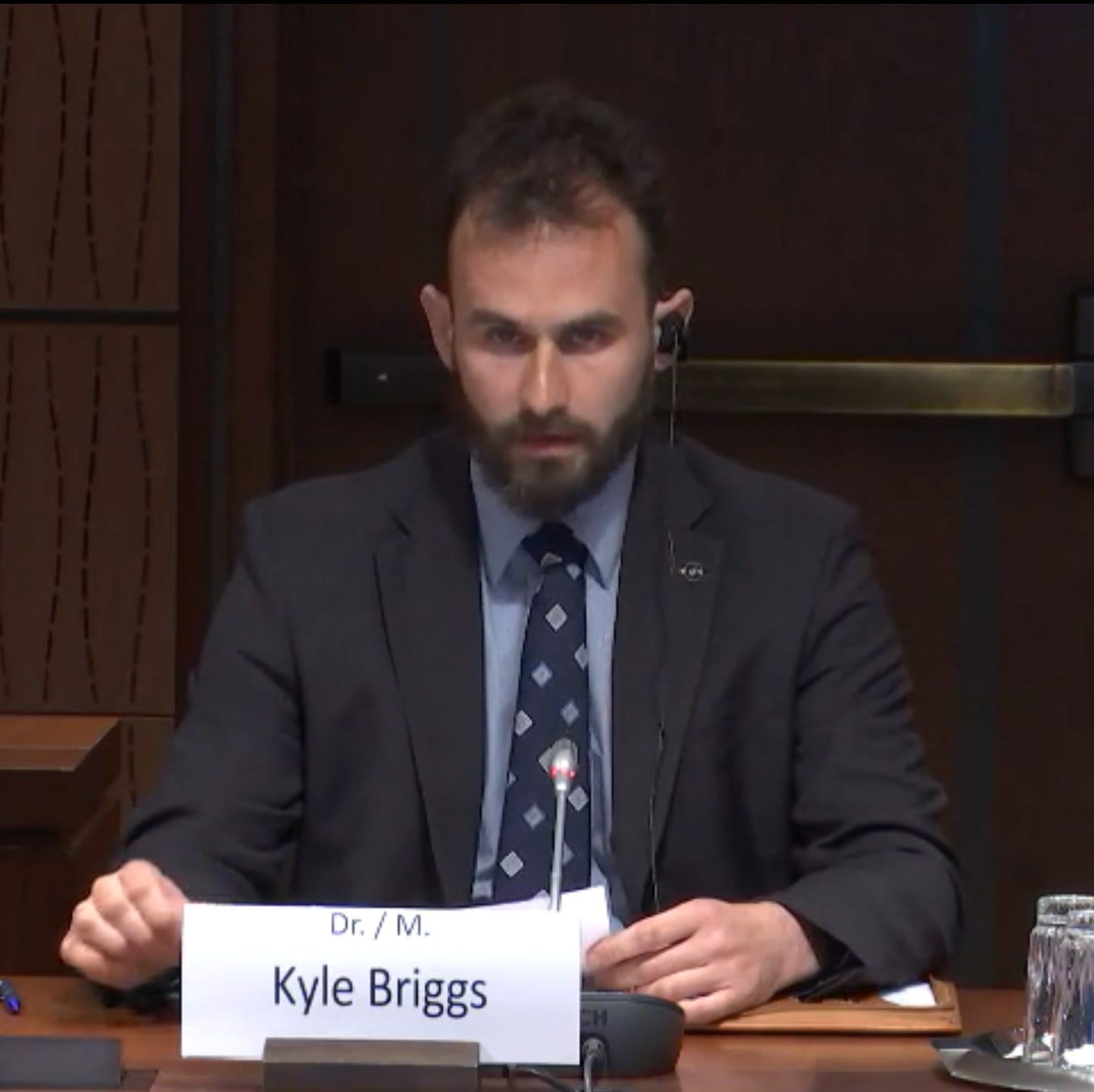
Last week I appeared as as witness before the House of Commons Standing Committee on Science and Research (SRSR) to discuss ways to overcome Canada’s challenges turning research into economic impact.
I was encouraged to note that I was not the only voice in the room calling for risk-tolerant capital to be deployed in support of research commercialization. Other notable points made by my colleagues (in particular Dr. Gerry Wright and Kevin Dahl from ElevateIP Alberta, with whom I am in full agreement), relate to a pressing need for
funding specific to early-stage startups commercializing research;
funding for IP creation, protection, retention, and strategy;
IP-based valuation tools and IP-backed lending mechanisms; and
moving away from input metrics like research spending as indicators of impact and toward actually measuring the resulting outputs.
My presentation is shown in the excerpt below, and you can watch the full proceedings at the link underneath.
Transcript of Opening Remarks
Thank you Honourable Chair Zahid, Vice-chairs and Committee members for the invitation to speak to you on commercializing innovation emerging from publicly funded research at Canadian universities.
To briefly introduce myself, I am a physicist and the Entrepreneur in Residence at the Faculty of Science at the University of Ottawa. I was the CEO of Northern Nanopore Instruments, a nanotechnology startup built from my PhD research that we sold in Fall 2023. I am now the author of the CanInnovate blog on innovation policy and, alongside TJ Misra and David Durand, co-author of the Simple Agreement for Innovation Licensing (SAIL) and co-founder of the SAIL Initiative, through which we aim to streamline how new technologies get from lab to market.
The value of research follows a power law distribution: a small minority of new technologies eventually create most of the economic value, but it is impossible to reliably predict which ones will succeed or be valuable when the research is transferred to the private sector. Because of this impossibility, it is more important to make sure that we do not miss the valuable minority than it is to make sure that every attempt is successful. It follows that the most effective strategy for commercializing research successfully is to invest relatively small amounts of capital early in almost everything. Mostly, Canada does not do this.
Attempts to commercialize research have failure rates above 90%, but the successes create more than enough value to offset the cost of the failures. Countries that “invest well” have three things in common, namely, the public sector:
funds innovative startups before they have revenues,
usually favours new startups over existing companies as vehicles of innovation, and
is willing to let previously-funded projects fail when necessary.
This approach to funding serves to derisk innovative companies to the point where they can attract private sector investment, and ensures that valuable technologies do not slip through the cracks.
Ironically, systemic risk intolerance in the Canadian public sector mostly prevents it from funding pre-revenue companies in this way, and Canadian VCs cannot address the gap because of the long timelines involved. We must reframe how we evaluate and manage risk. We must understand that most investments will fail, and that this is acceptable as long as the combined return over time is positive. So while it may be true to say that our public sector has become too risk averse, I argue that “investing in almost everything” is in fact less risky (or at least more likely to produce a positive outcome).
Another element common to effective commercialization elsewhere is harmonized innovation policy. The United States has the Bayh-Dole Act, for example, that guides how universities transfer technologies to the private sector. In Canada, we lack even an attempt at national coordination. Senator Colin Deacon’s office recently found 134 different innovation funding programs at the federal level alone, and the tri-council agencies provide no top-down guidance on how universities should manage research IP. As a result, every research institution has a different IP policy, licensing negotiations with most research institutions are slow, no two licences are alike, and there is no standard for data collection on licensing or outcomes.
To address these challenges, my colleagues and I developed SAIL. SAIL is a licence framework designed to support harmonized and streamlined Canadian tech transfer from research institutions to startups. After consulting with a national community of innovation stakeholders, we designed SAIL based on 6 axioms of tech transfer specific to Canada’s unique challenges. It asks universities to play the role of “first investor” in research commercialization and rewards them with a pre-defined amount of convertible debt in exchange. The framework can be easily amended (with legal advice) to support a variety of startups more efficiently and effectively than building a new licence from scratch every time.
We are also working to adapt a risk-tolerant funding mechanism that has been highly successful in the UK, where it created an estimated $7 of economic value for every $1 of input. This model uses venture philanthropy delivered through a public-private partnership, combining public funds with private donations and university contributions to create a charitable investment fund that reinvests all returns to ensure that it is self-sustaining. Variations on this model have been implemented at a handful of Canadian research institutions, most notably the UCeed fund in Calgary, and we propose to implement it at the national level.
Policies to promote and grow private sector investment in research can only be effective if we increase the pool of investable, innovative companies. To do that, we must first build a better bridge from lab to market. I recommend that Canada:
embrace strategic risk-taking: deploy public funding toward pre-revenue startups commercializing Canadian research by trialling venture philanthropy delivered as a public-private partnership with a national scope, and
nationally harmonize a Canada-first approach to management of the IP arising from publicly funded research.
Thank you distinguished members of this Committee for your time. I look forward to your questions.